William James on the Psychology of Habit
By Maria Popova
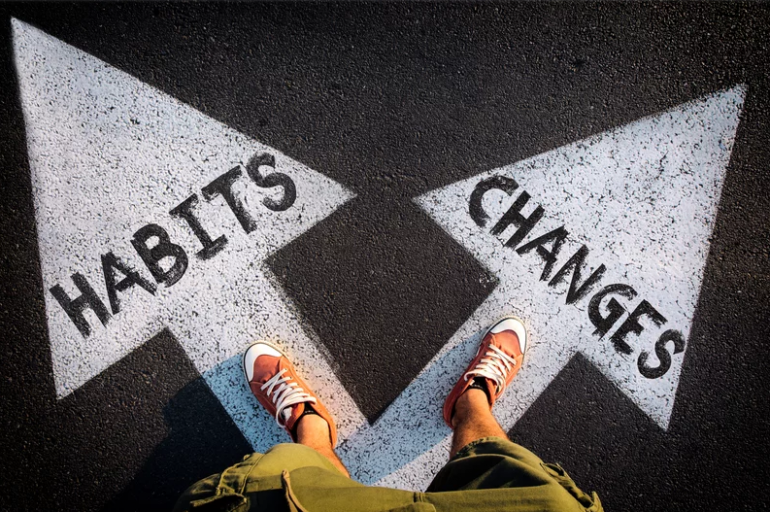
“We are what we repeatedly do,” Aristotle famously proclaimed. “Excellence, then, is not an act, but a habit.” Perhaps the most fascinating element in Michael Lewis's recent Vanity Fair profile of Barack Obama is, in fact, the president's relationship with habit; particularly his optimization of everyday behaviors to the point where they demand the minimum possible cognitive load, allowing him to focus on important decisions, on excellence.
I found this interesting not merely out of self-interest, though it did validate the fact that I've eaten the same breakfast every day for nearly a decade (steel-cut oats, nonfat Greek yogurt, whey protein powder, seasonal fruit), but also because it's not a new idea. In fact, the same principles Obama applies to the architecture of his daily life are those that pioneering psychologist and philosopher William James wrote about in 1887, when he composed Habit (public library; public domain) - a brief treatise on how our patterns of behavior shape who we are and what we often refer to as character and personality.
When we look at living creatures from an external point of view, one of the first things that strikes us is that they are bundles of habits. In wild animals, the habitual cycle of daily behavior seems a necessity implanted at birth; in domesticated animals, and especially in humans, it seems in large measure to be the result of education. Those habits for which there is an inborn tendency are called instincts; some of those due to education would be called by most people acts of reason. Thus it appears that habit covers a very large part of life, and that whoever dedicates himself to studying the objective manifestations of mind is obliged from the start to define clearly what its limits are.
James begins with a strictly scientific and physiological account of the brain and our deeply rooted patterns of information, exploring the notion of neuroplasticity a century before it became a term in popular modern neuroscience, and offering this elegant definition:
Plasticity, in the wide sense of the word, means the possession of a structure weak enough to yield to an influence, but strong enough not to yield all at once.
He then bridges body and mind to clarify how "habit loops" dominate our lives:
What is so plainly true of the nervous apparatus of our life animal can hardly be different from what is true of the automatic activity of the mind. Any sequence of mental action which has been frequently repeated tends to perpetuate itself; so that we find ourselves automatically prompted to think, feel, or do what we have been accustomed to think, feel, or do under like circumstances, without any consciously formed purpose or anticipation of results.
He finally brings this lens to social science, painting a somewhat sinister picture of habit as a kind of trance:
Habit is thus the enormous flywheel of society, its most precious conservative agent. It alone is what keeps us all within the bounds of order, and saves the children of fortune from the envious uprisings of the poor. It alone prevents the hardest and most repulsive walks of life from being deserted by those brought up to tread therein. It keeps the fisherman and the deck-hand at sea in winter; it holds the miner in his darkness, and nails the countryman to his log-cabin and his lonely farm through all the months of snow; it protects us from invasion by the natives of the desert and the frozen zone. It dooms us all to fight out the battle of life upon the lines of our nurture or our early choice, and to make the best of a pursuit that disagrees, because there is no other for which we are fitted, and it is too late to begin again. It keeps different social strata from mixing. Already at the age of twenty-five you see the professional mannerism settling down on the young commercial traveller, on the young doctor, on the young minister, on the young counsellor. You see the little lines of cleavage running through the character, the tricks of thought, the prejudices, the ways of the "shop," in a word, from which the man can by-and-by no more escape than his coat-sleeve can suddenly fall into a new set of folds. On the whole, it is best he should not escape. It is well for the world that in most of us, by the age of thirty, the character has set like plaster, and will never soften again.
This brings us to the question of education, whose responsibility it is to oversee the formation of habit and restrict the daily deliberations from which Obama happily freed himself:
The great thing, then, in all education, is to make our nervous system our ally instead of our enemy. It is to fund and capitalize our acquisitions, and live at ease upon the interest of the fund. For this we must make automatic and habitual, as early as possible, as many useful actions as we can, and guard against the growing into ways that are likely to be disadvantageous to us, as we should guard against the plague. The more of the details of our daily life we can hand over to the effortless custody of automatism, the more our higher powers of mind will be set free for their own proper work. There is no more miserable human being than one in whom nothing is habitual but indecision, and for whom the lighting of every cigar, the drinking of every cup, the time of rising and going to bed every day, and the beginning of every bit of work, are subjects of express volitional deliberation.
He goes on to offer three maxims for the successful formation of new habits:
1. In the acquisition of a new habit, or the leaving off of an old one, we must take care to launch ourselves with as strong and decided an initiative as possible. Accumulate all the possible circumstances that shall reinforce the right motives; put yourself assiduously in conditions that encourage the new way; make engagements incompatible with the old; take a public pledge, if the case allows; in short, envelop your resolution with every aid you know. This will give your new beginning such a momentum that the temptation to break down will not occur as soon as it otherwise might; and every day during which a breakdown is postponed adds to the chances of its not occurring at all.
2. Never suffer an exception to occur till the new habit is securely rooted in your life. Each lapse is like the letting fall of a ball of string which one is carefully winding up; a single slip undoes more than a great many turns will wind again. Continuity of training is the great means of making the nervous system act infallibly right; and is the best safeguard against those ever-lurking sources of error and failure. It is surprising how soon a desire will die of inanition if it be never fed.
3. Seize the very first possible opportunity to act on every resolution you make, and on every emotional prompting you may experience in the direction of the habits you aspire to gain. It is not in the moment of their forming, but in the moment of their producing motor effects, that resolves and aspirations communicate the new "set" to the brain.
Naturally, as is often the case with famous advice, James immediately follows with a caveat that echoes Joan Didion's eloquent definition of character:
No matter how full a reservoir of maxims one may possess, and no matter how good one's sentiments may be, if one have not taken advantage of every concrete opportunity to act, one's character may remain entirely unaffected for the better. With mere good intentions, hell is proverbially paved. And this is an obvious consequence of the principles we have laid down. A "character" is in this sense a completely fashioned will; and a will, in the sense in which he means it, is an aggregate of tendencies to act in a firm, prompt, and definite way upon all the principal emergencies of life. A tendency to act only becomes effectively ingrained in us in proportion to the uninterrupted frequency with which the actions actually occur, and the brain "grows" to their use.
He makes a case, once more, for consistency of effort, offering one final maxim:
As the present writer has elsewhere urged, the hell to be endured hereafter, of which theology tells, is no worse than the hell we make for ourselves in this world by habitually fashioning our characters in the wrong way. Could the young but realize how soon they will become mere bundles of habits, they would give more heed to their conduct while in the plastic state. We are spinning our own fates, good or bad, and never to be undone. Every smallest stroke of virtue or of vice leaves its never so little scar. The drunken Rip Van Winkle, in Jefferson's play, excuses himself for every fresh dereliction by saying, "I won't count this time!" Well! he may not count it, and a kind Heaven may not count it; but it is being counted none the less. Down among his nerve-cells and fibres the molecules are counting it, registering and storing it up to be used against him when the next temptation comes. Nothing we ever do is, in strict scientific literality, wiped out.
James concludes with a timeless validation of courage as the secret to success:
Let no young man or woman make the mistake of supposing that he or she is too insignificant, and of too little moment to be worth attention in this world. The very smallest modicum of energy, if it be really done, counts in the whole world's total of energy, and may turn the scale in the struggle now waging between the forces of good and evil. Every stroke of your work counts, every bit of help, however humble, is helping to turn the tide. But the attention and effort must be constant. This is the great thing to remember. Especially must you beware of becoming too much absorbed in the details of your business to lose sight of the larger purpose. Silently, between all the details of your business, the power of judging in all that class of matter will have built itself up within you as a possession that will never pass away. Young people should know this truth in advance. Ignorance of it has probably engendered more discouragement and dejection in young people embarking on arduous careers than all other causes combined.
Originally published at Brain Pickings